Thursday, September 18, 2008

Ultraefficient Photovoltaics


A solar cell more than twice as efficient as typical rooftop solar panels has been developed by Spectrolab, a Boeing subsidiary based in Sylmar, CA. It makes use of a highly customizable and virtually unexplored class of materials that could lead to further jumps in efficiency over the next decade, making solar power less expensive than grid electricity in much of the world.

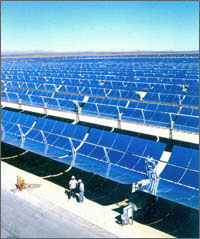
The cell, which employs new "metamorphic" materials, is designed for photovoltaic systems that use lenses and mirrors to concentrate the sun's rays onto small, high-efficiency solar cells, thereby requiring far less semiconductor material than conventional solar panels. Last month Spectrolab published in the journal Applied Physics Letters the first details on its record-setting cell, initially disclosed in December, which converts 40.7 percent of incoming light into electricity at 240-fold solar concentration--a healthy 1.4 percent increase over the company's previous world-record cell. Other groups are developing promising cells based on the new type of materials, including researchers at the Department of Energy's National Renewable Energy Laboratory (NREL), in Golden, CO. The NREL researchers will soon publish results in the same journal showing that their NREL's designs are tracking Spectrolab's, improving from 37.9 percent efficiency in early 2005 to 38.9 percent efficiency today.

Metamorphic semiconductors resemble the high-efficiency cells used in space. Like the cells that grace satellites and planetary landers, they employ three layers of semiconductors, each tuned to capture a slice of the solar spectrum (solar panels have only one active layer). These semiconductor layers are assembled, one upon the next, by altering elements fed to a crystal growing in a vacuum. To avoid growing crystals filled with energy-trapping defects, device designers have until recently employed only a limited repertoire of semiconductors, such as germanium and gallium arsenide, which form similar crystal structures.

Metamorphic materials provide flexibility by throwing off this structural constraint, employing a wide range of materials, including those with mismatched structures. "The parameter space you can explore using mismatch opens up a whole world of possibilities," says NREL principal scientist Sarah Kurtz.

What makes this possible is the addition of buffer layers between the semiconductor layers. This technique was employed in the early 1990s to make high-speed transistors combining silicon and germanium, and then introduced to photovoltaics later in the decade by Cleveland-based semiconductor developer Essential Research. Spectrolab has, however, seen the best results. Its 40.7 percent metamorphic cell improves on Spectrolab's best conventional cells by incorporating new semiconductors in the top and middle layers that excel at capturing infrared light that was all but missed by the cell's predecessors.

Such high output may be just the beginning. Raed Sherif, director of concentrator products at Spectrolab, says there is every reason to believe that these metamorphic solar cells will top 45 percent and perhaps even 50 percent efficiency. Sherif says those efficiencies, combined with the vast reduction in materials made possible by 1,000-fold concentrators, could rapidly reduce the cost of producing solar power. "Concentrated photovoltaics are a relatively late entry in the field, but it will catch up very quickly in terms of cost," he predicts.

Wednesday, September 17, 2008

Solar Energy The Future

Here's a look at some things we can expect in the future from solar technologies.

All our buildings will feature energy-efficient design, construction, and materials as well as renewable energy technologies. In effect, each building will both conserve energy and produce its own supply, to be one of a new generation of cost-effective "zero-energy buildings" that have no net annual need for nonrenewable energy.

In photovoltaic research and development, there will be more breakthroughs in new materials, cell designs, and novel approaches to product development. In a solar future, your mode of transportation—and even the clothes you wear—could produce clean, safe electric power.

With today's technology roadmaps to lead the way, concentrating solar power will be fully competitive with conventional power-generating technologies within a decade. Concentrating solar power, or solar thermal electricity, could harness enough of the sun's energy to provide large-scale, domestically secure, and environmentally friendly electricity, especially in the southwestern United States.

The enormous solar power potential of the Southwest—comparable in scale to the huge hydropower resource of the Northwest—will be realized. A desert area 10 miles by 15 miles could provide 20,000 megawatts of power, and the electricity needs of the entire United States could theoretically be met by a photovoltaic array within an area 100 miles on a side.

Within 5 years, photovoltaic power will be competitive in price with traditional sources of electricity.

Solar electricity will be used in an electrolysis process that separates the hydrogen and oxygen in water so the hydrogen can be used in fuel cells for transportation and in buildings.


Here are two real world experimental examples taking place right now

1)
Photo of a home, built by students from the University of Colorado (CU) for the first Solar Decathlon.
This home, built by students from the University of Colorado (CU) for the first Solar Decathlon, could be a model for energy-efficient solar homes of the future. In the Solar Decathlon, a competition sponsored by the Department of Energy, student teams are challenged to integrate aesthetics and modern conveniences with maximum energy production and optimal efficiency. Each collegiate team builds a uniquely designed 500- to 800-square-foot house. In 2002, all the houses were transported to the National Mall in Washington, D.C., where the CU team took first prize overall.


2)
Photo of  state-of-the-art hydrogen fuel cell buses.
SunLine, a California transit agency, is adding state-of-the-art hydrogen fuel cell buses to its fleets and setting up facilities for fueling and maintenance. Hydrogen is produced at the site using solar-powered electrolysis and natural gas reforming. Because fuel cell buses aren't yet commercially available, demonstration projects help us understand the technology better and plan for the future.

Monday, September 15, 2008

How do Photovoltaics Work?


Photovoltaics is the direct conversion of light into electricity at the atomic level. Some materials exhibit a property known as the photoelectric effect that causes them to absorb photons of light and release electrons. When these free electrons are captured, an electric current results that can be used as electricity.

The photoelectric effect was first noted by a French physicist, Edmund Bequerel, in 1839, who found that certain materials would produce small amounts of electric current when exposed to light. In 1905, Albert Einstein described the nature of light and the photoelectric effect on which photovoltaic technology is based, for which he later won a Nobel prize in physics. The first photovoltaic module was built by Bell Laboratories in 1954. It was billed as a solar battery and was mostly just a curiosity as it was too expensive to gain widespread use. In the 1960s, the space industry began to make the first serious use of the technology to provide power aboard spacecraft. Through the space programs, the technology advanced, its reliability was established, and the cost began to decline. During the energy crisis in the 1970s, photovoltaic technology gained recognition as a source of power for non-space applications.

see caption

The diagram above illustrates the operation of a basic photovoltaic cell, also called a solar cell. Solar cells are made of the same kinds of semiconductor materials, such as silicon, used in the microelectronics industry. For solar cells, a thin semiconductor wafer is specially treated to form an electric field, positive on one side and negative on the other. When light energy strikes the solar cell, electrons are knocked loose from the atoms in the semiconductor material. If electrical conductors are attached to the positive and negative sides, forming an electrical circuit, the electrons can be captured in the form of an electric current -- that is, electricity. This electricity can then be used to power a load, such as a light or a tool.

A number of solar cells electrically connected to each other and mounted in a support structure or frame is called a photovoltaic module. Modules are designed to supply electricity at a certain voltage, such as a common 12 volts system. The current produced is directly dependent on how much light strikes the module.

see caption

Multiple modules can be wired together to form an array. In general, the larger the area of a module or array, the more electricity that will be produced. Photovoltaic modules and arrays produce direct-current (dc) electricity. They can be connected in both series and parallel electrical arrangements to produce any required voltage and current combination.

see captionToday's most common PV devices use a single junction, or interface, to create an electric field within a semiconductor such as a PV cell. In a single-junction PV cell, only photons whose energy is equal to or greater than the band gap the cell material can free an electron for an electric circuit. In other words, the photovoltaic response of single-junction cells is limited to the portion of the sun's spectrum whose energy is above the band gap of the absorbing material, and lower-energy photons are not used.

One way to get around this limitation is to use two (or more) different cells, with more than one band gap and more than one junction, to generate a voltage. These are referred to as "multijunction" cells (also called "cascade" or "tandem" cells). Multijunction devices can achieve a higher total conversion efficiency because they can convert more of the energy spectrum of light to electricity.

As shown below, a multijunction device is a stack of individual single-junction cells in descending order of band gap (Eg). The top cell captures the high-energy photons and passes the rest of the photons on to be absorbed by lower-band-gap cells.

see captionMuch of today's research in multijunction cells focuses on gallium arsenide as one (or all) of the component cells. Such cells have reached efficiencies of around 35% under concentrated sunlight. Other materials studied for multijunction devices have been amorphous silicon and copper indium diselenide.

As an example, the multijunction device below uses a top cell of gallium indium phosphide, "a tunnel junction," to aid the flow of electrons between the cells, and a bottom cell of gallium arsenide.

Photovoltaics- A General Overview


Photovoltaics (PV) is the field of technology and research related to the application of solar cells for energy by converting sunlight directly into electricity. Due to the growing need for solar energy, the manufacture of solar cells and photovoltaic arrays has expanded dramatically in recent years. Photovoltaic production has been doubling every two years, increasing by an average of 48 percent each year since 2002, making it the world’s fastest-growing energy technology. At the end of 2007, according to preliminary data, cumulative global production was 12,400 megawatts.Roughly 90% of this generating capacity consists of grid-tied electrical systems. Such installations may be ground-mounted (and sometimes integrated with farming and grazing) or built into the roof or walls of a building, known as Building Integrated Photovoltaic or BIPV for short. Financial incentives, such as preferential feed-in tariffs for solar-generated electricity, and net metering, have supported solar PV installations in many countries including Germany, Japan, and the United States.

Solar Energy- A General Overview


Solar energy refers to the utilization of the radiant energy from the Sun. Solar power is used interchangeably with solar energy, but refers more specifically to the conversion of sunlight into electricity, either by photovoltaics and concentrating solar thermal devices, or by one of several experimental technologies such as thermoelectric converters, solar chimneys or solar ponds.

Solar energy and shading are important considerations in building design. Thermal mass is used to conserve the heat that sunshine delivers to all buildings. Daylighting techniques optimize the use of light in buildings. Solar water heaters heat swimming pools and provide domestic hot water.
In agriculture, greenhouses expand growing seasons and pumps powered by solar cells. Evaporation ponds are used to harvest salt and clean waste streams of contaminants. (known as photovoltaics) provide water for grazing animals. Solar distillation and disinfection techniques produce potable water for millions of people worldwide. Simple applications include clotheslines and solar cookers which concentrate sunlight for cooking, drying and pasteurization. More sophisticated technologies concentrate sunlight for high-temperature material testing, metal smelting and industrial chemical solar vehicles provide ground, air and sea transportation production.